During a large-scale EHR transition across a multi-site specialty care network, I led the redesign of a high-risk workflow supporting pump-based medication management.
Spanning clinical care, operations, and inventory, this workflow required precise coordination — where breakdowns could directly impact patient safety and continuity of treatment.
The existing process relied on manual tracking, fragmented documentation, and informal communication across teams. As the system scaled, these gaps introduced delays, increased risk, and limited visibility into critical patient and medication data.
Redesigning a fragmented,high-risk workflow into a connected care experience.
OVERVIEW
Pump Workflow Redesign
The workflow was operationally fragile and highly dependent on individual knowledge and workarounds. Critical steps were: difficult to track consistently; distributed across multiple systems and formats; time-sensitive with limited visibility; prone to breakdowns across team handoffs. This created risk for delays, inconsistencies, and gaps in care delivery—especially during a system transition.
Critical steps were:
-
Difficult to track consistently.
-
Distributed across multiple systems and formats.
-
Time-sensitive with limited visibility.
-
Prone to breakdowns across team handoffs.
This created risk for delays, inconsistencies, and gaps in care delivery.
01 – The Challenge

Risk Mapping
-
By layering risk analysis onto the workflow, I identified where the process was most vulnerable to failure, particularly in areas involving manual tracking, time-sensitive actions, and cross-team communication.
-
These breakdown points became critical inputs for prioritizing workflow redesign and system support.
Risks / Breakdown
Points
-
Ownership of critical steps was often unclear.
-
Information lived in multiple disconnected places.
-
Manual tracking created gaps in continuity.
-
Communication across teams lacked consistency and traceability. Timing-sensitive steps relied heavily on individual follow-through.
Key Insights
I expanded the workflow into a service blueprint to capture both visible interactions and behind-the-scenes processes across teams.
This helped surface hidden dependencies between clinical staff, operational roles, and external coordination points that were not immediately visible in the workflow alone.

Current Service Blueprint
I approached this as a service design problem, mapping the end-to-end workflow across clinical, operational, and coordination layers.
-
Documenting current-state workflows across locations
-
Identifying variations in execution between teams
-
Surfacing dependencies across roles and systems
-
Highlighting breakdown points and risk areas
The goal was to translate a complex, informal process into something structured, visible, and scalable
02– The Approach
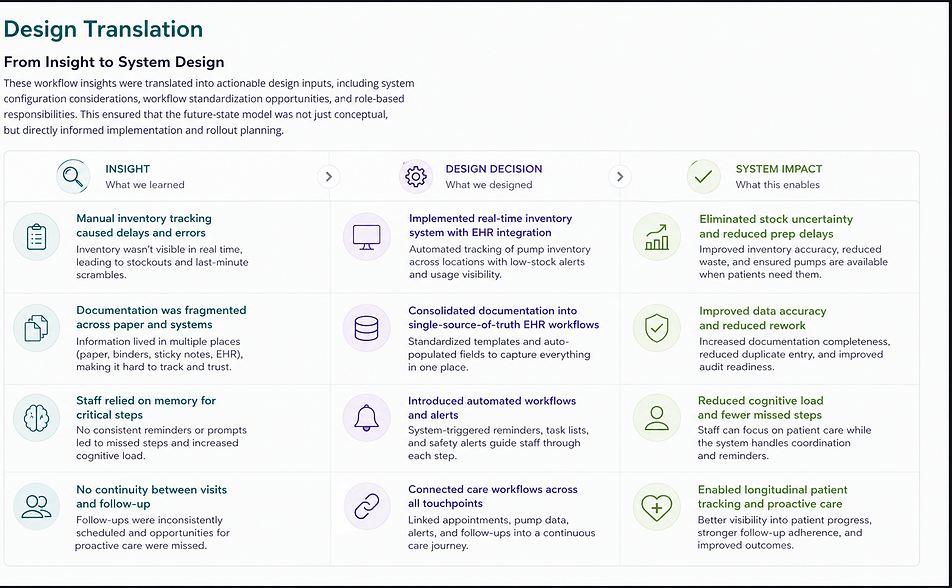
These workflow insights were translated into actionable design inputs, including system configuration considerations, workflow standardization opportunities, and role-based responsibilities. This ensured that the future-state model was not just conceptual, but directly informed implementation and rollout planning.
From Insight to System Design
Design Translation
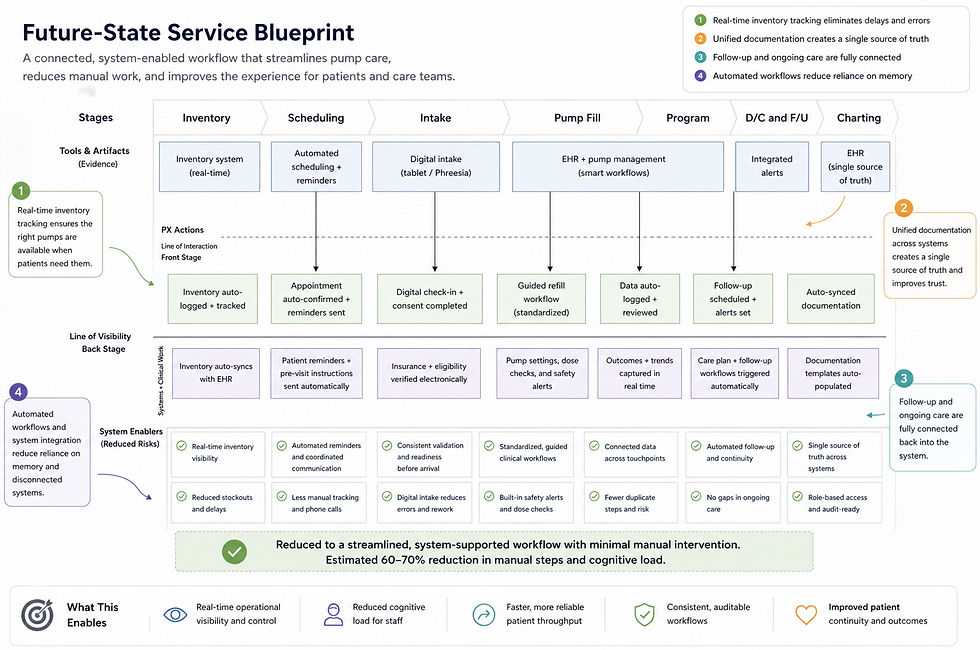
Based on these insights, I defined a future-state workflow designed to improve visibility, ownership, and coordination across the system.
The proposed model reduces reliance on manual processes while creating a more structured and consistent approach to managing complex care workflows.
Future State Workflow
I defined a future-state workflow designed to improve structure, visibility, and coordination across the system.
The proposed model focused on
-
Standardizing how key steps are documented.
-
Establishing clearer ownership across roles.
-
Reducing reliance on manual tracking methods,
-
Improving alignment between clinical and operational workflows.
03 – The Solution