

Heading 5
Heading 5
01 - Summary
Transforming Care Plan Management for Scalable, Coordinated Home Care
Care teams at Help at Home were managing care plans across fragmented systems, manual workflows, and inconsistent data,resulting in administrative overload, poor visibility, and delayed patient care.
I led a service and system redesign of the Navigator platform, identifying breakdowns across data, workflows, and coordination. By integrating Salesforce with EHR systems and redesigning care plan workflows, we reduced administrative burden, improved data reliability, and enabled more proactive, coordinated care delivery.
Impact:
· 50% reduction in documentation workload
· 30% decrease in backlog tasks
· Improved care coordination and a 30% reduction in ER visits
System Model: Fragmented Data Ecosystem

02 - System Context
Constraints & Considerations
The Navigator platform functioned as a coordination layer built on Salesforce, while critical patient data remained distributed across external EHR systems.
This created a fragmented ecosystem where workflows, data ownership, and system interactions were not aligned—forcing care teams to manually bridge gaps between platforms.
Change Management Risk:
Caregivers and administrative staff rely on established workflows, requiring solutions that are intuitive and minimize disruption to daily operations.
Regulatory & Compliance Constraints:
The system must adhere to HIPAA and other healthcare regulations, adding complexity to data handling, integration, and system design decisions.
Operational Constraints:
Limited resources and technical dependencies required prioritizing high-impact solutions that could be implemented within existing system limitations.
Scalability Requirements:
Solutions needed to support increasing patient volumes while maintaining performance, reliability, and usability across multiple markets.
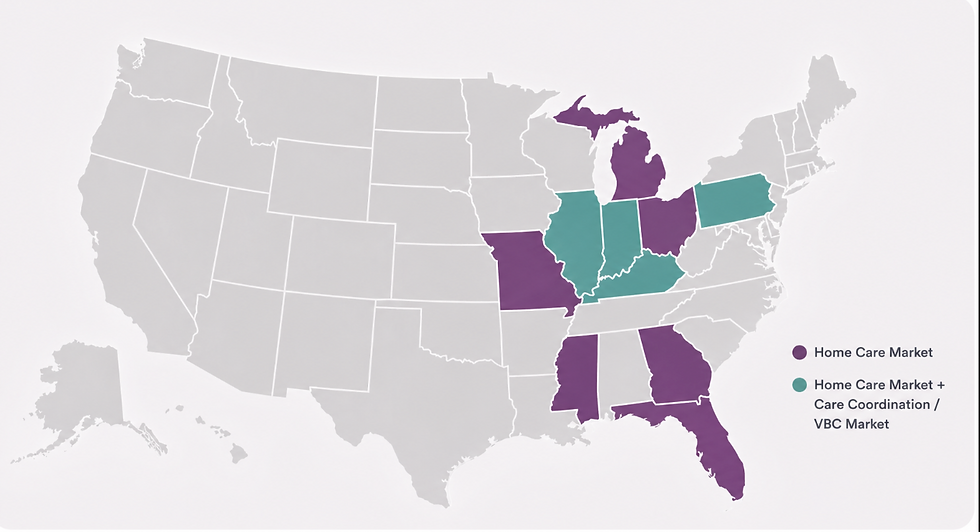
Help at Home Demographics
03. Strategic Goals
Key goals:
-
Reduce manual data entry and duplicate workflows
-
Improve real-time data synchronization between EHR and Salesforce
-
Streamline care plan creation and management
-
Enhance usability for caregivers and field staff
-
Enable more reliable reporting and operational visibility
Redesign the Help at Home Navigator experience to reduce administrative burden, improve data accuracy, and streamline care plan management across systems.

Discovery
Discovery: Identifying System Breakdowns
To uncover the root causes behind care plan inefficiencies, I conducted research across caregivers, administrators, and data teams—mapping both the user experience and the underlying system dependencies.
Approach:
-
Stakeholder interviews across clinical, operational, and technical roles.
-
End-to-end workflow mapping of care plan creation and management.
-
System audit of EHR and Salesforce data flows.
-
Review of reporting structures and data inconsistencies.
What emerged:
-
Fragmented workflows
Care teams navigated multiple systems with little integration, increasing cognitive load and time to complete tasks. -
Manual data duplication
Key care plan information had to be re-entered across systems, introducing errors and inconsistencies. -
Lack of real-time synchronization
Delays between EHR and Salesforce created misaligned data and unreliable reporting. -
Operational inefficiencies at scale
Small workflow breakdowns compounded into significant backlo and administrative burden.
These insights reveled that the core issue was not just the interface, but a lack of coordination across systems, data, and workflows.
The existing care plan workflow revealed not just usability issues, but deeper system fragmentation across tools, data, and roles.
While the interface required multiple steps to complete a care plan, the root challenge was a lack of coordination between systems and processes.
Key breakdowns:
-
Disconnected systems
EHR and Salesforce operated in parallel rather than as a unified ecosystem, requiring users to manually bridge gaps between platforms.
-
Redundant data entry
Critical patient and care plan information had to be repeatedly entered, increasing time spent and risk of inconsistencies.
-
Workflow fragmentation
Tasks were spread across multiple screens and tools, forcing users to context-switch and increasing cognitive load.
-
Limited data visibility
Lack of real-time synchronization made it difficult for care teams to trust the accuracy of information -
Operational inefficiency at scale.
What appeared as minor UX friction compounded into significant delays, backlog, and reduced care team productivity.
Impact:
These breakdowns extended beyond user frustration — they directly affected care coordination, reporting reliability, and the organization’s ability to scale efficiently.
Current State & System Gaps
Fragmented Care Plan Workflow
(Current State)
This workflow illustrates how fragmented systems, manual data entry, and disconnected steps contribute to inefficiencies in care plan creation.

-
Manual data re-entry across systems
-
Lack of real-time synchronization between EHR and Salesforce
-
High cognitive load due to context switching
-
No centralized source of truth
What this reveals:

Ideation
04.- Opportunity Areas
Based on these insights, the opportunity was not to optimize individual screens, but to redesign how systems, data, and workflows work together to support care plan management.
PILLAR 1
Unify Data Across Systems
-
Enable real-time synchronization between EHR and Salesforce.
-
Reduce duplicate data entry through shared data models.
-
Establish a single source of truth for care plan information.
PILLAR 2
Streamline Care Plan Workflows.
-
Reduce multi-step processes into guided, end-to-end flows.
-
Automate repetitive tasks such as data entry and role assignment.
-
Minimize context switching across systems.
PILLAR 3
Improve Visibility & Decision-Making
-
Provide real-time access to accurate patient and care plan data
-
Standardize reporting structures for consistency
-
Surface key insights to support proactive care coordination
PILLAR 4
Design for Scale & Adoption
-
Create workflows that support increasing patient volume
-
Ensure solutions align with existing clinical operations
-
Reduce training burden through intuitive system design
05- Future State: Unified Care Plan Workflow
The redesigned workflow focuses on unifying systems, reducing manual effort, and enabling real-time coordination across care teams.
By integrating EHR and Salesforce data, streamlining workflows, and automating key steps, the new experience supports faster, more reliable care plan management at scale.

Key Improvements
-
Eliminated duplicate data entry through system integration and auto-population
-
Reduced workflow complexity by consolidating steps into a single guided flow
-
Enabled real-time visibility across care teams through synchronized data
-
Improved efficiency at scale by minimizing manual work and cognitive load
The redesigned workflow focuses on unifying systems, reducing manual effort, and enabling real-time coordination across care teams.
By integrating EHR and Salesforce data, streamlining workflows, and automating key steps, the new experience supports faster, more reliable care plan management at scale.

Outcome
06- Results & System Impact
Impact
-
50% reduction in documentation workload.
-
30% decrease in backlog tasks.
-
Improved care coordination, contributing to a 30% reduction in ER visits.
System-Level Impact
-
Established a single source of truth across EHR and Salesforce.
-
Reduced reliance on manual workarounds and duplicate processes.
-
Enabled real-time visibility for care teams and administrators.
-
Improved the system’s ability to scale across markets and patient volume.
Rather than optimizing individual interactions, this redesign focused on how the system operates as a whole, resulting in meaningful improvements to both care team efficiency and patient outcomes.

Reflection
-
Designing at the system level requires aligning stakeholders, data, and workflows—not just improving interfaces
-
Early system mapping was critical in identifying root causes beyond surface-level UX issues
-
Future opportunities include expanding automation and predictive insights to further support proactive care